
Average Cost for a Land Survey: Why Location and History Matter
Two neighbors. Same street. Same lot size. One pays $600 for a land survey. The other pays $2,100. Both quotes came from licensed surveyors. Neither firm was overcharging. The difference came down to one thing: how much legwork the surveyor had to do before setting foot on the property.
Most people shop for survey quotes by size and type. That’s not wrong, but it misses the bigger cost driver. The history of a parcel and the state of local records have more impact on final price than almost anything else.
What the Average Cost for a Land Survey Actually Covers
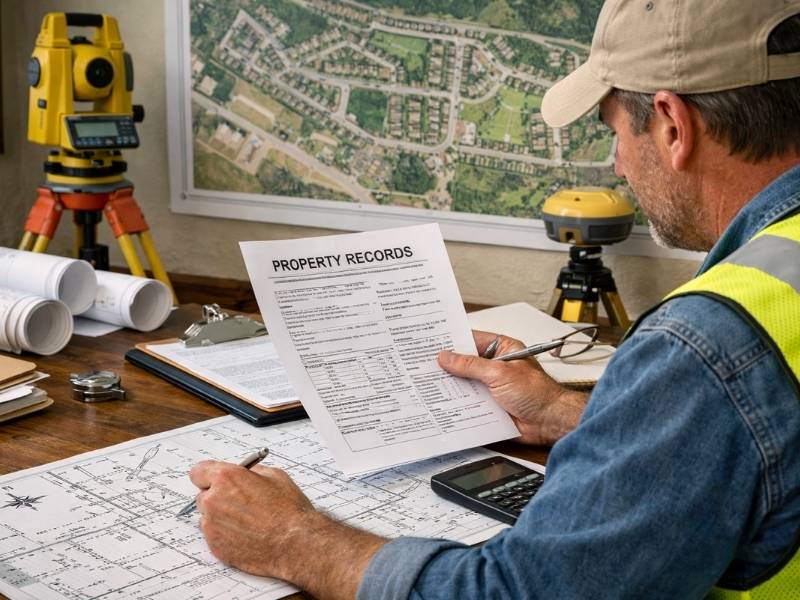
A survey quote isn’t just paying for a person with equipment to walk your lot. You’re paying for research, field work, calculations and a stamped legal document.
Here’s what goes into a typical residential boundary survey:
- Deed and title research to find the legal description of the parcel
- Review of adjacent parcel records and recorded plats
- Field work to locate existing monuments, pins and physical markers
- Calculations to resolve any gaps or conflicts in the record
- Drafting of the final survey document
- Licensing fees and professional liability
The field visit is often the shortest part of the job. A surveyor might spend two hours on your lot and four hours in the records room. You pay for both.
Why Location Changes the Price
Local record quality varies a lot by region and municipality. Some counties have well-maintained digital archives going back decades. Others have partial records, paper documents that were never digitized and gaps that require a surveyor to trace adjacent parcels to piece together the legal boundary.
Urban lots in well-developed areas often have clean records. Rural parcels, older subdivisions and land that changed hands informally over many years can require significantly more research.
Permitting fees are another location-based factor. Some municipalities charge a fee to file a survey or plat of record. Those costs pass through to the client.
Access matters too. A flat, open lot in a dense suburb is faster to work than a wooded parcel with steep grade changes and difficult corner access. Travel time to remote locations adds to the total.
Why Property History Drives Survey Cost More Than Most People Expect
This is where quotes vary the most.
A parcel with a clean chain of title, recorded plat and existing survey monuments already in place can be surveyed quickly. The surveyor finds the pins, confirms they match the record and produces the document. Straightforward.
A parcel with any of the following conditions takes longer and costs more:
- No prior survey on record
- Conflicting deeds from previous owners
- Missing or disturbed boundary monuments that need to be re-established
- Gaps or overlaps in the recorded plat
- Lot lines that don’t close mathematically when the old deed descriptions are run through calculations
- Easements that were recorded informally or not at all
Older properties in any market often carry some version of these issues. A parcel that was originally part of a farm, carved off informally and sold multiple times before the area was formally platted is going to take real research to sort out. That research time shows up in the quote.
Typical Price Ranges by Survey Type
These are general ranges for residential parcels. Commercial, industrial and rural parcels run higher.
Boundary Survey: $500 to $1,500 for a standard residential lot with clean records. Complex parcels with research issues can reach $2,500 or more.
Topographic Survey: $800 to $2,000 for residential lots. Higher for large parcels or steep terrain. Adds elevation data for design and drainage work.
ALTA/NSPS Survey: $2,000 to $5,000 and up. Used for commercial transactions. The most detailed and standardized survey type. Requires coordination with title companies and compliance with national standards.
These ranges shift based on the factors covered above. A boundary survey on a lot with a clean 1990s plat and existing pins will come in near the low end. A boundary survey on a lot with a 1940s deed and no prior survey will come in near the high end, or above it.
What Developers Should Ask for Before Getting a Quote
Don’t just ask what the survey costs. Ask what factors might change that number.
Tell the surveyor:
- When the parcel was last surveyed (if known)
- Whether you have a copy of any prior survey
- Whether the lot was part of a larger parcel that was divided
- Whether there are any known boundary disputes with adjacent owners
- What you plan to use the survey for
A surveyor who asks these questions back is doing their job. One who quotes a flat rate without asking about parcel history may be leaving out research costs that show up later as a scope change.
Get the quote in writing. Ask whether it’s fixed-fee or time-and-materials. Ask what triggers a price increase. A fixed-fee quote on a simple parcel is reasonable. A fixed-fee quote on a complex parcel with unknown history should make you ask how the surveyor is accounting for research risk.
When Paying More Upfront Saves Money Later
A cheaper survey that misses a conflict in the records doesn’t save money. It defers the problem.
If a boundary issue surfaces after a structure is built, costs escalate fast. Attorneys get involved. Adjacent owners get involved. Title companies get involved. A few hundred dollars of extra survey research upfront is not comparable to what those conversations cost.
Licensed surveyors carry professional liability insurance for a reason. If they produce a document that turns out to be wrong due to their error, that coverage matters. An unlicensed person charging half the price of a licensed surveyor carries no such protection.
How to Get a Quote That Actually Reflects the Real Cost
The best way to avoid surprise invoices is to give the surveyor enough information to price the job accurately from the start.
Pull together what you have before making the call. That means any prior survey documents, the current deed, and the parcel ID number from the county assessor. If you know the parcel was part of a larger tract that was subdivided, say so. If you know the corners haven’t been located in years, say that too.
A surveyor who can review that information before quoting will give you a more reliable number. One who quotes without it is guessing, and that guess often goes up once they start pulling records.
Fixed-fee quotes are worth asking for on simple, well-documented parcels. Time-and-materials is more honest on parcels with real unknowns. Both are legitimate. The key is knowing which one you’re getting and what changes the price.
Paying for a proper survey done right costs far less than paying an attorney to fix what a bad one missed.
Frequently Asked Questions
Can I get a land survey for a flat fee, or is it always time-and-materials?
Both pricing models exist. Fixed-fee quotes are common for straightforward residential parcels where the surveyor can assess complexity upfront. Time-and-materials pricing applies when record quality is unknown or the parcel has a complicated history. Always ask which model applies and what triggers a scope change.
Does the size of the lot determine the price?
Lot size is one factor, but record history and terrain often matter more. A large parcel with a clean survey history and existing monuments can cost less than a small lot with conflicting deeds and missing pins. Ask the surveyor how they’re pricing the job, not just how big the lot is.
Is an old survey from 20 years ago good enough for a current project?
An old survey may still be useful as reference, but it won’t reflect changes since it was prepared. If structures have been added, fences moved or easements recorded since the original survey, a new survey is needed. Most lenders and municipalities require a current survey dated within a specific window.
Why would two surveyors quote very different prices for the same parcel?
Different firms price research risk differently. A firm that has already worked in the same subdivision and pulled the local records will have lower research costs. A firm coming in fresh may build in more time for unknown variables. The lower quote isn’t always the better deal. Ask both firms what’s included and what could increase the final price.
Who pays for a land survey in a real estate transaction?
This is negotiable. In many transactions, the buyer orders and pays for the survey as part of due diligence. In some cases, the seller provides an existing survey. Lenders sometimes require their own survey for loan processing. Who pays should be specified in the purchase agreement. Don’t assume it’s covered by someone else.
