↓
 

Minneapolis Land Surveying

Local Minneapolis Minnesota Land Surveyors

Minneapolis Land Surveying
  • Home
  • ALTA Survey
    • Minneapolis, MN
    • Saint Paul, MN
    • Bloomington, MN
    • Brooklyn Park, MN
    • Maple Grove, MN
    • Plymouth, MN
    • Rochester, MN
    • St Cloud, MN
  • Boundary Surveying
  • Construction Survey
  • Drone LiDAR Mapping
  • Elevation Certificate
  • Land Surveying
  • Topographic Survey
  • About Us
  • Blog
  • Contact Us
Home 1 2 3 … 6 7 >>

Post navigation

← Older posts

Welcome to Minneapolis Land Surveying

Minneapolis Land Surveying Posted on August 18, 2017 by MinneapoSurveyorNovember 13, 2019

This site is intended to provide you with information on Land Surveying in the Minneapolis MN and Hennepin County area of Minnesota (Tax Maps Link). If you’re looking for a Minneapolis Land Surveyor, you’ve come to the right place. If you’d rather talk to someone about your land surveying needs, please call our local number at (612) 712-4959 today. For more information, please continue to read. This is a marketing website for JLL Professional Services, LLC.

land surveying

Land Surveyors are professionals who make precise measurements to determine the size and boundaries of a piece of real estate.  While this is a simplistic definition, boundary surveying is one of the most common types of surveying related to home and land owners. If you fall into the following categories, please click on the appropriate link for more information on that subject:

Minneapolis Land Surveying services:

    1. I need to know where my property corners or property lines are. (Boundary Survey)
    2. I have a loan closing or re-finance coming up on my home in a subdivision. (Lot Survey)
    3. I need a map of my property with contour lines to show elevation differences for my architect or engineer. (Topo Survey)
    4. I’ve just been told I’m in a flood zone or I’ve been told I need an elevation certificate in order to obtain flood insurance or prove I don’t need it. (Flood Survey)
    5. I’m purchasing a lot/house in a recorded subdivision. (Lot Survey – See Boundary Survey if you’re not in a subdivision.)
    6. I’m purchasing a larger tract of land, acreage, that hasn’t been subdivided in the past. (Boundary Survey)

Contact us for your Minneapolis Land Surveying needes TODAY at (612) 712-4959.

Posted in boundary surveying, elevation certificate, land surveying, land surveyor | Tagged boundary survey, land surveyor, land surveyor minneapolis mn, Minneapolis Land Surveying

Home Surveys and Why Buyers Should Not Skip Them

Homebuyer standing outside a house before purchase, highlighting the importance of a home survey and property boundaries

A buyer closes on a property. Six months later, they find out the fence their neighbor put up three years ago sits four feet inside their lot. The neighbor won’t move it. The title company says it’s not their problem. The attorney bills start piling up. All of it could have been caught before closing with a proper home survey.

Skipping a survey to save $500 on a $400,000 purchase is one of the worst financial decisions a buyer can make. The math doesn’t work in your favor.

What a Home Survey Actually Tells You

A home survey is a field-verified document prepared by a licensed land surveyor. It shows the legal boundaries of a parcel, the location of existing structures, and any encroachments or easements on the property.

It is not a home inspection. A home inspection looks at the condition of the building. A survey looks at the land itself and where everything sits on it.

These are two separate documents. You need both.

What Buyers Find Out From Home Surveys

Most buyers assume the property they’re buying matches what’s described in the listing. That assumption fails more often than it should.

A survey can reveal:

  • A structure that crosses a property line onto adjacent land
  • A neighbor’s driveway, shed or fence that sits inside the subject property
  • A utility easement that cuts through the yard and limits what can be built there
  • A garage or addition that was built too close to the property line and doesn’t meet current setback requirements
  • Lot dimensions that don’t match what the listing stated

None of these issues appear in a title search. Title searches look at recorded documents. A survey looks at what’s actually on the ground.

Why Title Insurance Doesn’t Replace a Survey

Title insurance is not the same as a survey, and buyers often confuse the two.

Title insurance protects against defects in the chain of ownership. It covers things like forged deeds, unpaid liens, or errors in public records. What most standard title policies don’t cover is physical encroachments that would have been visible from a current survey.

Read that again. If you don’t get a survey and an encroachment exists, many title policies won’t pay out because the issue was “discoverable.” You had the chance to find it and didn’t.

Some lenders require an ALTA survey for commercial transactions. For residential deals, surveys are often optional. Optional doesn’t mean unnecessary.

When to Order a Home Survey in the Buying Process

Order it during the due diligence period. That window exists for a reason.

Most purchase agreements give buyers a set number of days to inspect the property and back out if something material comes up. A survey finding qualifies as a material issue. If the survey reveals an encroachment or easement that affects the intended use of the property, the buyer has grounds to renegotiate or walk away.

Order it after the purchase agreement is signed and before the due diligence window closes. Don’t wait until closing week.

The surveyor needs time to pull existing records, schedule field work and prepare the final document. Depending on the firm and the complexity of the parcel, that can take one to three weeks. Build it into the timeline.

Types of Surveys Relevant to Home Purchases

Not every survey is the same. Here’s what buyers commonly encounter.

Boundary Survey This is the base-level document. It verifies the legal corners of the lot and shows where the property lines actually fall. For residential purchases, this is the minimum a buyer should request.

Mortgage Location Survey or ILC An Improvement Location Certificate shows where existing structures sit relative to the lot lines. It’s cheaper than a full boundary survey but offers less legal protection. Some lenders accept it in place of a boundary survey, but it’s not the same thing and shouldn’t be treated as equivalent.

Topographic Survey Useful if the buyer plans to build, grade or add drainage improvements. Shows elevation changes across the lot. Buyers who plan to develop the property further should ask about this.

For a standard home purchase with no planned construction, a current boundary survey is what you need.

What Happens If You Skip the Survey and Find a Problem Later

Discovering an encroachment after closing puts the buyer in a difficult position. Options typically include:

  • Negotiating a boundary line agreement with the adjacent property owner (requires both parties to agree and legal documentation)
  • Filing a quiet title action to establish legal ownership of the disputed area (expensive and slow)
  • Removing the encroaching structure if it’s on your side (your cost)
  • Living with the problem and disclosing it when you sell

None of these are good. The legal fees alone on a boundary dispute can run $5,000 to $30,000 or more, depending on how contested the issue becomes. Surveys typically cost $400 to $1,200 for a standard residential parcel.

Who Can Legally Prepare a Home Survey

Only a licensed professional land surveyor (PLS or RPLS depending on the state) can prepare a legally valid boundary survey. The requirements for licensure include a combination of education, field experience and a state licensing exam.

Don’t accept a survey prepared by an unlicensed person. Don’t accept a copy of an old plat map and assume it’s current. Property conditions change. Structures get added. Fences move. The survey needs to reflect current conditions.

Verify the surveyor’s license through your state licensing board before hiring.

Frequently Asked Questions

Is a home survey required to buy a house?

In most residential transactions, a survey is optional rather than required by law. Some lenders require one for certain loan types. Even when it’s optional, skipping it creates real risk. An undiscovered encroachment or easement can become a legal and financial problem after closing.

How long does a home survey take?

Most residential boundary surveys take one to three weeks from the time of order. That includes pulling existing deed records, scheduling field work and preparing the final document. Order early in the due diligence period, not at the end.

Can an old survey from a previous sale be used?

Old surveys may no longer reflect current conditions. Structures can be added, fences can move and lot line agreements can be recorded after a survey was prepared. Ask the surveyor to review the existing document. In many cases, an update or new survey is the safer choice.

What’s the difference between a boundary survey and an ILC?

A boundary survey establishes the legal corners of the lot through field measurement. An Improvement Location Certificate shows where structures sit relative to the approximate boundary. The ILC is faster and cheaper, but it doesn’t carry the same legal weight. If you’re buying a property and want a document you can rely on in a dispute, a boundary survey is the stronger choice.

What should a buyer do if the survey finds a problem?

Bring it to your real estate attorney before closing. Depending on what the survey shows, options include negotiating a price reduction, requiring the seller to resolve the issue before closing, or backing out during the due diligence period. Don’t close on a known boundary problem without a written resolution in place.

Posted on June 10, 2026 by MinneapoSurveyorJune 9, 2026

How to Find Property Lines Before Starting a Backyard Project

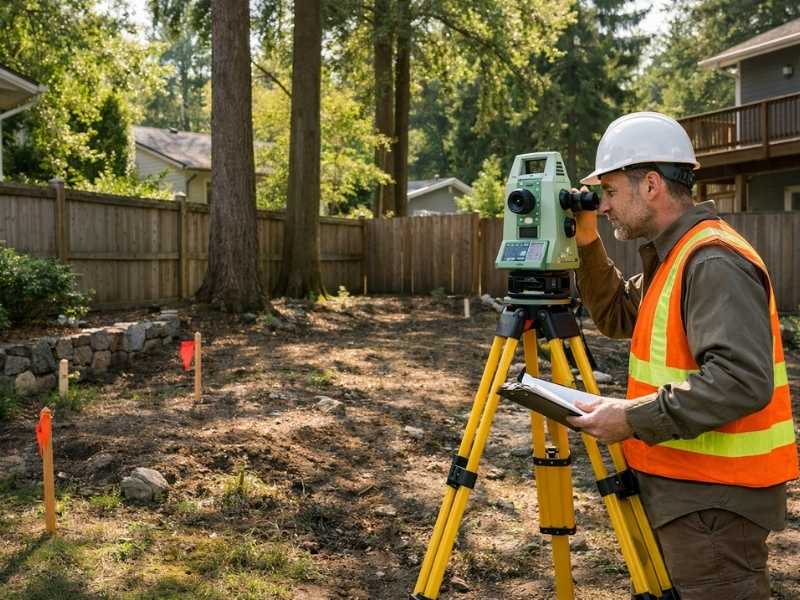
Land surveyor using surveying equipment to mark property lines before a backyard construction project

Starting a construction project on a property without knowing your exact boundaries can trigger major legal headaches. You might pour a new patio, put up a privacy fence or build an outdoor kitchen. If your building crew crosses over the official property lines by even an inch, your neighbor can legally force you to tear the whole project down. Finding out how to locate these boundaries keeps your development legal, on schedule and within budget.

Checking the Official Property Records

Local government offices store detailed records for every parcel of land. You can find original subdivision maps at your county recorder or planning office. These papers show the exact shapes and dimensions of the lots in your area.

The legal description on your deed provides the baseline data. It lists the exact angles and distances of your boundaries. You can use these numbers to plan where your backyard equipment can safely dig.

Reading Your Official Map to Find Property Lines

A plot map shows a birds eye view of your land. It notes exactly where your house sits in relation to the outer boundaries.

  • Measurements showing the distance from your back wall to the rear line
  • Angles that show how your side boundaries turn
  • The locations of nearby streets and shared utility zones
  • North arrows that help you align the document with your yard

Finding Metal Markers in the Dirt

Past crews usually drove iron pins deep into the ground at every major corner. Over time, grass, dirt and fallen leaves cover up these markers.

Using a Metal Detector to Hunt for Markers

You can rent a commercial locator device to scan your lawn. Sweep the device slowly over the areas where your plot map says the corners should be. The machine will make a sharp sound when it passes over a buried iron pipe or rod.

Digging Carefully at the Corners

Once you get a strong signal, scrape away the top layer of sod with a hand shovel. Do not use heavy machinery for this step. You want to see the top of the metal pin without knocking it out of place.

Spotting Visual Clues Left by Past Builders

Older neighborhoods often have physical indicators that hint at the legal lines. These hints are not official proof, but they help your crew narrow down the search area.

Look for old concrete monuments or wooden hubs buried flush with the soil. You might also spot ancient fence posts or old tree lines that follow a straight path. Compare these items with your deed measurements to see if they align with the official records.

Hiring a Professional to Mark Property Lines

Relying on old fences or your own measurements can lead to expensive mistakes. If your project involves pouring permanent concrete, you need absolute certainty.

A licensed expert uses precision GPS gear and robotic transit tools to map the land. They do the heavy research at the county office to verify conflicting records. They will place bright stakes along the line so your construction crew knows exactly where to stop working.

Getting Legal Clearance Before You Dig

Buried utility lines often run right along the edges of your lot. Hitting a live power cable or a gas main can cause severe injuries and shut down your site for weeks.

Most regions have a free utility location service. You call them a few days before your crew arrives. Workers will come out and spray paint your lawn to show the path of every underground pipe. This step ensures your backyard excavation stays completely safe.

Frequently Asked Questions

Can I use a smartphone app to locate my exact boundaries?

No, phone apps rely on general GPS data that can be off by several feet. They are fine for a rough estimate, but they are not accurate enough for building permanent structures or fences.

What should I do if my neighbor disputes my project location?

Stop all construction work immediately to avoid extra financial risk. Hire a licensed land expert to run a formal boundary assessment. The certified map they produce serves as the official legal proof of your lines.

Are utility easements considered part of my neighbor’s land?

No, you own the land inside an easement, but utility providers have a legal right to access it. You cannot build permanent structures like brick outdoor kitchens or concrete patios inside these zones.

What happens if I cannot find the original iron pins?

If the original markers are missing, you must hire a professional crew to reset them. They will measure from distant neighborhood markers to recalculate and drive new pins into the ground.

Why do old fences often sit in the wrong spot?

Past owners often built fences without checking their deeds, or they placed them inward to avoid trees. A fence shows where someone chose to build, not where the legal line actually sits.

Posted on June 9, 2026 by MinneapoSurveyorJune 9, 2026

Post navigation

← Older posts

Contact Us

    © Copyright Minneapolis Land Surveying
    Minneapolis, Minnesota
    Phone: (612) 712-4959

    Privacy Policy | Terms of Use
    ↑